
.

The above is the latest addition to my music playback system – a 30 years old Linn Sondek LP12 turntable bearing serial number 35xxx fitted with Rega RB700 tonearm, Michell Tecnoweight and Denon DL-160 high output moving coil cartridge.
The turntable was purchased used direct from UK and has just been restored to pristine condition. It had arrived in a generally fair state considering its age and needed a major overhaul with replacement of few worn-out parts plus some restoration works, hence it was delivered straight to a friend (CM) upon own collection from Cargo Village in LCCT Sepang and payment of 10% sales tax to Malaysian Kastam. The turntable was quickly stripped down to loose bits within some 20 minutes.
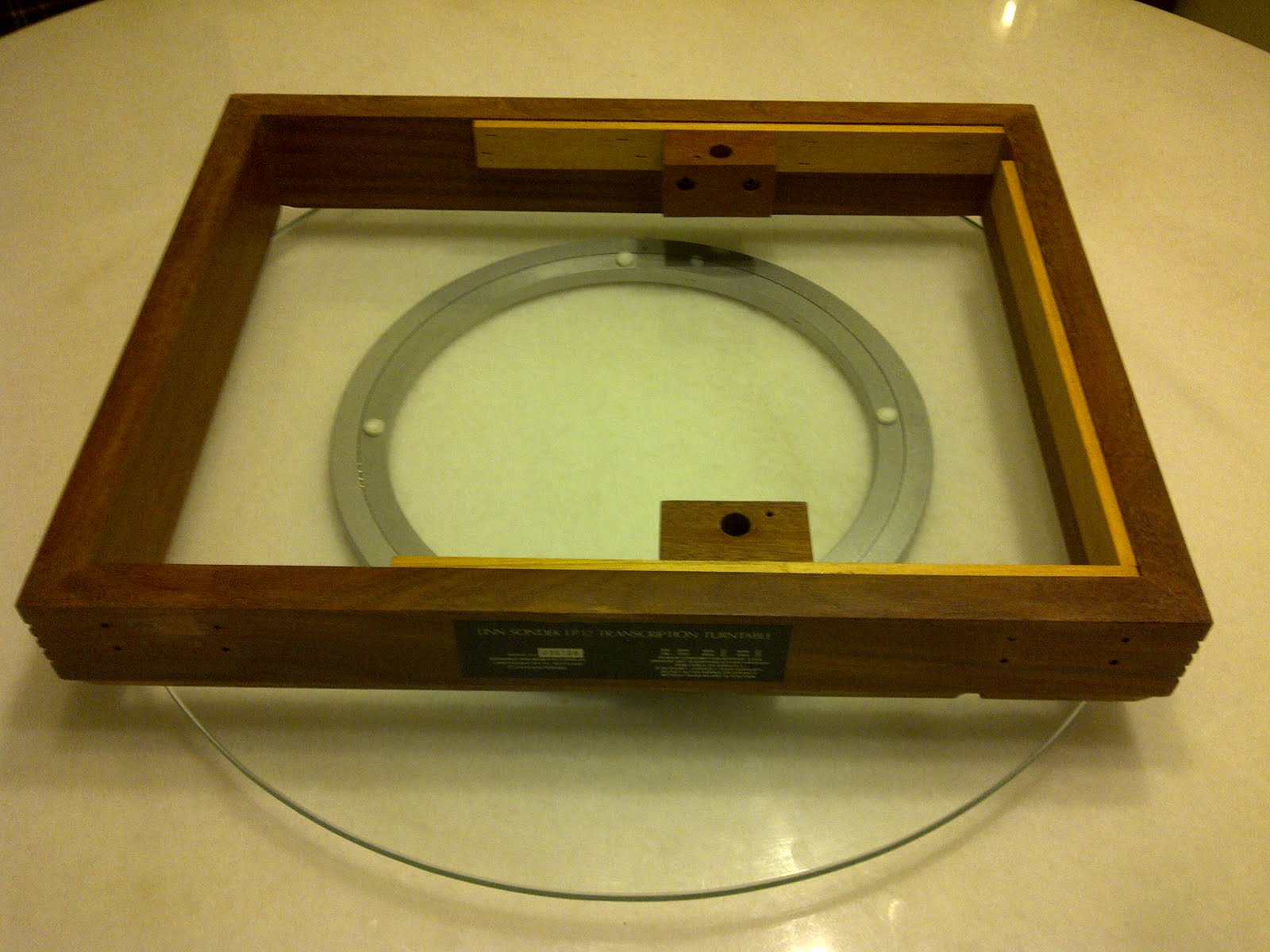 The plinth is a fluted Afromosia without corner bracing and there were some scuffles on its frontal panel, a small dent right in the middle of outer top edge behind and was mildly warped. To rectify these defects, lacquer on the varnished sections and black paint at its bottom were painstakingly stripped off, dent and scuffles patched with wood fillers before the entire plinth was sanded down to smoothen out any unevenness and to a fine finish. CM's own words are: "Surface preparation is of utmost importance" and he set out to work on it meticulously before applying several coats of Walnut wood stain with oil and then rubbed off with plain cloth so as to give the plinth a rich colour in satin finish without use of any lacquer. The end result is a beautifully restored plinth as could be seen from the 2 pictures above.
 The turntable is fitted with an early Contrology-made Valhalla but it was dead on arrival. CM rebuilt it by replacing the critical parts including capacitors, IC chips, crystal, bridge rectifier, thermistor, varistors, 15K resistors with new and better-rated parts sourced from RS Electronics / Element 14 / Jalan Pasar and incorporated the factory upgrade in new diode modification found in later Valhalla into it. The end result is a super Valhalla being given a new lease of life and tuned to supply a constant 85V to the LP12 motor and starts or stops smoothly without causing any shudder to the turntable and most important of all, a spot-on 33 1/3 RPM speed that will surely give any brand new Hercules II a run for their money if one is not keen to play 45 RPM records on the LP12.
The motor is a 31 years old Philips unit that has its plastic thrust bearing partially worn-out. CM serviced it by cleaning the belt pulley, removed dirt accumulated over the years with an air-pressured blower before replacing the plastic bearing with a smaller SKF metal ball bearing and a custom-designed brass bearing housing after which the motor runs frictionless that no vibration could be felt when our hands are placed on the top plate nearest to the motor. This translates to a lower floor noise and inner details are more discernable.
The stainless steel top plate was chemically cleaned and buffed along its lines after which the 2 screw holes which had sinked slightly resultant from its overtightening to the plinth previously were duly rectified.
The subchassis supplied with LP12 in the early 80s is the spot-welded type but mine was fitted with the epoxy glued-on type, obviously having been replaced by the previous owner. The latter type of subchassis is clearly a better unit that yields better sonic quality over the former type. I had prior to this purchased another near mint epoxy glued-on subchassis with black liner bearing, hence these 2 newer items were fitted into my LP12 at the end of the restoration process.
The LP12 platters are made of Mazak 8 alloy of magnesium and aluminium. Earlier platters actually have a higher content of magnesium over aluminium, heavier and their finish duller than newer ones. These earlier platters are quite sought after by those LP12 owners who love the vintage flavour due to presence of midrange magic (thicker, warmer, forward-sounding vocals which bloom and have body) and there are more bass weights and grunts to the bass, albeit slower. Newer LP12 platters have better treble heights and sound more dynamic, spacious (but slightly hazy), leaner and faster which are more preferred by modern day fundamental Linnies. The thin layer of lacquer coating of both the platter and subplatter tend to discolour and disintegrate over time. CM scrapped off the old lacquer of my units with paint remover and then sprayed a new thin layer of lacquer onto them after which they were polished to an even surface finish.
The new parts replacing worn-out ones include an armboard spotting the new Linn LP12 logo with Rega cut, 1 genuine belt, 1 Rega platter mat, 1 genuine suspension kit (3 springs, 3 top grommets, 3 bottom grommets and 3 Turret nuts), 4 rubber feet, 5 M5 tensile screws, 6 genuine plastic clips (genuine P clip too) and 1 Michell Unicover (arriving soon). I had wanted to acquire a brand new genuine Linn clear lid and hinges but as these items are removed and put aside during listening sessions, I scrapped the idea and opted for the more affordable and stylish acrylic cover in Michell Unicover.
 The Rega RB700 tonearm (£460), Michell Tecnoweight (£89), 2mm 3-points alloy spacer and Denon DL-160 HOMC cartridge are from my previous Rega P5 swapped with a recently-acquired brand new Rega RB250 tonearm plus the original RB700 stainless steel counterweight thrown in. A word of appreciation here to the friend who had suggested that I swap them. CM mounted my RB700 tonearm onto the Linn armboard with drilled-through screws and nuts and this method (as opposed to use of wood screws like those on a Rega P5) supposedly improves the bass responses. The original cartridge clips of RB700 were quite badly corroded and replaced with 24K gold-plated ones after which the solder joints were sleeved with heat shrinks in matching colours. The cartridge was then perfectly aligned using the Rega Stevenson Arc.
CM did not use any talcum powder to fit the suspension kit into the turntable. Once properly setup, my newly restored Linn LP12 sounds way better than my previous Rega P5 in the overall balance of presence, lushness, sound staging capability and PRaT although my tonearm, cartridge and phono stage remain unchanged. I have also tried out an earlier heavier platter and whilst I love the midrange magic and weightier bass I heard with most genres of music especially vocals, I thought music was overly warm and too fat for string instruments such as violin and Chinese pipa. The newer lighter platter resonates more and is more at home with all types of music except that it could sound a little too devoid of character and slightly diffuse on another LP12. I managed to eliminate any such shortcoming by opting for a pair of WBT 2016 interconnects fitted with Swithcraft RCA plugs (soldering job again by CM).
A lot of us would surely love to own a spanking new Linn LP12 if only we could ever afford one but a top-spec LP12 at RM72,000 is clearly beyond my reach and Linn no longer sell a basic LP12 table without Linn Majik PSU and ProJect 9cc carbon tonearm. Newer LP12 with corner-braced plinth and lighter platter presents music in a more 'modern' (faster, tighter and bass firmer) sound and is claimed to be more consistent-sounding between one unit from another. When we are buying used, I am of opinion that we should opt for a latest minter rather than an early unit like mine and every LP12 purchased used ought to be serviced and set-up properly prior to it being plonked into our systems. I am extremely lucky to have known a very capable friend in CM who has rebuilt my LP12 from the condition it was in and saved me lots of money in the process. IMHO, the newer LP12 excites us more whereas an early LP12 soothes us. I favour an in-between of the two and that is exactly what my LP12 is now. There is no hard and fast rules to this preference for it is whatever that floats your boat!
.


